
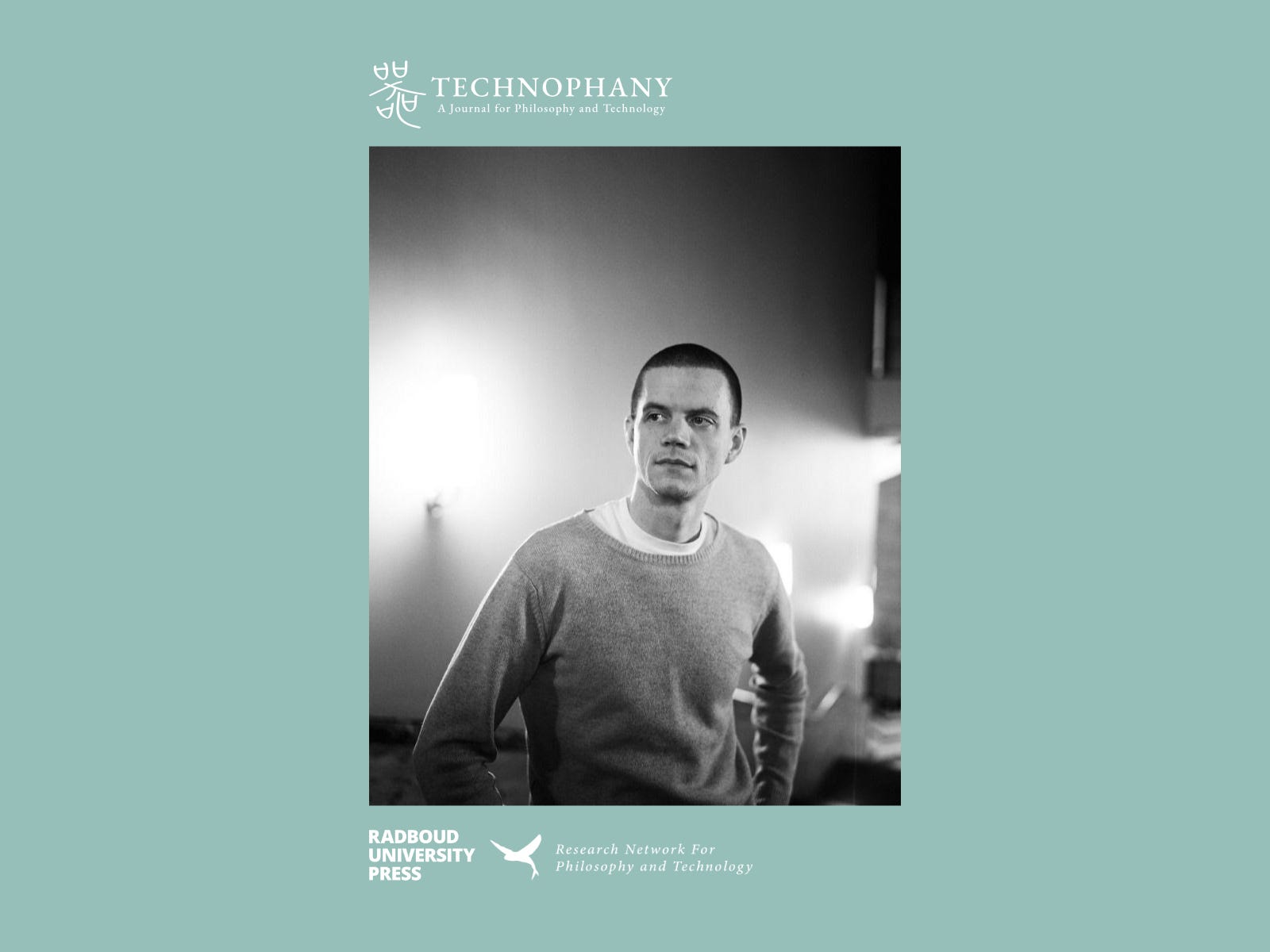
Alexander Galloway’s expertise lies in his synthesis of philosophy on the analog and the digital, and, crucially, modes of thought which uphold that distinction. Galloway’s thoughtful analysis relies on historical rigour, combining theoretical critique with rich archival material—such as his recreation of Guy Debord’s boardgame ‘Kriegspiel’ through computer code, discussed in his book Uncomputable: Play and Politics in the Long Digital Age (2021), or his evaluation of Friedrich Kittler’s lesser-known archive of computer code. In this interview, Galloway discusses his recent publication in Digital Theory (2025), which untangles the philosophical decision of discretization—the principal mode underlying the digital, as opposed to, for example, the ‘continuous’ or the ‘plane immanence’. While discourse on AI proliferates, Galloway takes us back a step to think critically about the fundamental model of the digital and provides ground for further discourse vis-à-vis axiomatic arguments.[1] In this interview by Ben Pulver, Galloway is asked about his decision to write (or not to write) about AI; the affordances of the axiomatic mode; discretization and digital arithmetic in Marx; Float Fusion, the REAL, and Lacan; Heidegger’s ‘cybernetics-as-philosophy’s-end’; Deleuze as an analog philosopher; signal jamming; and the role of the critic.
Ben Pulver: You open your recent Float Fusion essay[2] with the claim that you don’t write about AI, yet the lecture you recently gave at the Weibel Institute for Digital Cultures, the October questionnaire (2024), and some of your other essays suggest otherwise; or, at least suggest that the refusal ‘to write about AI’ is a productive choice. I wonder whether the disavowal is itself methodological: whether writing about data types, thresholds, and axioms rather than “about AI” allows for a mode of analysis that other modes would foreclose. What does that refusal make possible?
Alexander Galloway: In general, I pursue a low-level intimacy with code and with software. Because of that, I have an informal rule where I try to engage with a topic at the level of code before or during the process of trying to write about it. So, an example: my dissertation and first book were on the internet protocols, and in those same years, I was also writing software that dealt with the internet protocols. Or my most recent book is called Uncomputable, and one of the methodological conceits of that book is that it grows out of a series of software studies made on algorithms found in the archive. There was a mathematician named Nils Aall Barricelli, who wrote one of the first cellular automata simulations from the early 1950s, and before writing on that, I rewrote his algorithm that he outlined in a white paper, so it would run on today’s machines. There are all sorts of benefits that come from this approach. It’s not a new approach. It’s the approach that designers and architects and people who have a practice; dancers, people working in certain kinds of performative art forms, all go through this iterative process of dealing with practice and then reflecting on it. That’s why I’ve kept relatively silent on two topics that have been important in recent digital studies. First, with Bitcoin and cryptocurrencies, I find the politics repulsive, but also the mathematics is incredibly sophisticated for encryption, and I don’t particularly want to write Bitcoin code on the blockchain. As for AI, the software is relatively straightforward, mostly because there are powerful mathematics libraries, and libraries that you can use for neural nets in a language like Python. From a software point of view, it’s not that sophisticated, but I just haven’t invested the time in understanding AI from the code side. But your question about affordances is interesting, and what this makes possible. Right now, the main interest for me is discretization: what is a measurement? What is a unit? What are the integers? What is the nature of grammè—the notion of the written mark that you find in people like Bernard Stiegler, or before him in Derrida, for example. So that’s how I’m circumventing the question and dealing with something that’s a little bit off to the side, but perhaps foundational for AI.
BP: Of your five axioms of AI (the Turing Test, the Eliza Effect, float fusion, scale, and arbitrage) you recently discussed in your Weibel lecture, I am curious if you can elaborate on them and how you landed on them as your five axioms? What is it about working with the axiomatic that you find appealing or strategic?
AG: The intervention is to identify a series of foundational assumptions or preconditions that are required for AI to work. My contention is that there are a series of these assumptions that aren’t explicitly stated. From one perspective, that reveals a kind of flaw. If AI is going to make claims about consciousness and truth, for instance, then it should be effectively grounded. These aren’t the only five. These are just some of the important ones that strike me as a prompt or a provocation to people who actually work on AI in order to fill in some of these gaps.
First, there’s the Turing test, which of course everyone writes about and talks about. But I think it’s important to stress that the Turing test isn’t a test so much as a piece of technology. It accomplishes a lot, and it gives AI some things for free that it can’t obtain otherwise. And what it gets for free is, of course, intelligence, and it does this through mimesis. If a machine can effectively perform mimesis vis-à-vis the human, then it is perforce nominated intelligent, and that strikes me as hugely significant, right? We need to be explicit about what the Turing test does. I think it’s probably the most important AI technology, because if you were to prohibit the Turing test or eliminate it, then it would be extremely difficult to make a claim about consciousness or truth vis-à-vis the ground, something like that, so that’s the most important one. I was also inspired by the so-called Eliza effect, which is a reference to the Eliza chatbot. If the Turing test is about an effective simulation that fools you or convinces you, the Eliza effect is the exact opposite. With Eliza, everyone knows the chatbot is stupid, but it doesn’t matter. It’s very similar to the process of disavowal in psychoanalysis, where you explicitly disavow the legitimacy of the device or the technology that you have, and it doesn’t matter because it still works. The Eliza chatbot could still be an effective therapist for you. So that’s also important for me because it doesn’t ground the machine–that’s what the Turing test does. The Eliza effect grounds you. It grounds the self; it firms up that segment of the foundation.
The essence of ‘float fusion’ is that digital computers use discrete values, and so it’s tricky or impossible for them to access continuous magnitudes. The analog manifold is, of course, fully theorized within mathematics. There are these things called irrational numbers, and in a pure sense, those are inaccessible to a terminated list of integers, which is what a decimal number is inside a computer. Float Fusion is the suggestion that we should explicitly proclaim that floating-point numbers are real numbers. You have to do that in order for the computer to be able to make any claim about reality, which includes discrete values and continuous values. Anyhow, these are some of the suggestions, that there are several gaps in the foundation of AI. It’s similar to set theory, where there’s an axiom of infinity. Mathematicians needed infinity to be available as a concept within set theory, and so they stipulated it at the level of the axioms.
Why am I drawn to the axiomatic? I think some people are turned off by this. I’m quite inspired by the work of Alain Badiou: he’s perfectly happy thinking in terms of stipulated rules or foundations that then you can build things from. And it seems like AI is in a position where we have to do that today.
BP: In your chapter “A Brief History of Digital Philosophy in 10 Expressions,” for Digital Theory (2025), you locate the first expression of digital philosophy in Marx in M–M′ (money into money prime), in that different things, once quantified by symbolic tokens, may be treated as the same — and you write that this discretization is not a natural fact but a decision within philosophy, an unnatural one, which ought to be denaturalized.[3] In the Weibel lecture you name arbitrage as one of your five axioms of AI. Is arbitrage the political-economic face of Marx’s notation A = B, the operation that profits from declaring non-identical things equivalent? And if the digital is a decision within philosophy rather than a “reality of natural discretization,” what would denaturalizing it require and what is at stake?
AG: I borrowed that from Fredric Jameson’s book called Representing Capital (2011).[4] He starts that book by saying that Capital gets its initial momentum from a couple of different riddles—things that are contradictory and don’t have an obvious answer. The first riddle is: how are two things that are totally different brought into equivalence in order to be exchanged. That’s a big riddle. How do you take two things that are qualitatively unique, that have different uses, and come from different places, were made by different people–how do you come to a marketplace and exchange them? Exchange requires a kind of algebraic equation. You have to say, for example, 20 of what you have equals 12 of what I have, and then we exchange them. That’s “20y = 12x” or something like that. Marx’s famous equation that he uses toward the beginning of Capital, vol. 1 is 20 yards of linen equals 1 coat. Although for me, discretization, which is to say the act of the digital, is somehow prior to that. In other words, you need a basis of common measurement in order to be able to make that algebraic expression. That’s at the heart of the digital theory that I’m exploring now; trying to understand what this shared basis is. Sometimes it’s called a monad. The monad is just the basis unit that is shared by both sides of the equation. In fact, it’s a very old technique. It’s evident in Euclid, and it goes all the way back to the Pythagoreans. It’s even in the concept of logos, a very important Greek term, which can mean speech, but it can also mean ratio, as in A/B. In that essay in Digital Theory, I explore the origins of this technology, and I think that discretization must be prior. ‘A = B’ is a consequence of forcing two qualitatively different things into a relationship of equal measure. Sometimes that forcing is violent, sometimes it’s not as violent. As for arbitrage, in a sense that comes later, because arbitrage is when you exploit local differences, right? So, in a sense, ironically, arbitrage is when you have equated two things, and then due to a kind of a gap, whether that’s a time delay or maybe it’s geography—if, for example, I live on one side of the hill, you live on the other side of the hill, and so even though two commodities are supposed to be the same value, I can transport the commodity, and I could exploit that geographic discrepancy. That’s the essence of arbitrage.
I try to treat the word ‘decision’ very literally. It’s the notion of a ‘cut,’ and at the center of the theory of the digital is this operation of discretization. The digital introduces difference, distinction, differentiation. In other words, it is a kind of cutting or the introduction of a gap, a stark differential between two different states. So I think of the digital as a decision in a very literal sense. It’s an incision; a cutting. But I like the double meaning of decision, because that implies that it’s an active choice, even if it’s not conscious. And if it is an active event of some kind, then maybe one can abstain from it. Maybe it’s possible to withdraw the decision. Maybe it’s possible not to participate in the cutting. If you do that, a variety of other options open up. There are different pathways.
I wrote a book on François Laruelle that tries to think through his extremely esoteric and complicated work, which is sometimes called Non-Standard Philosophy.[5] According to his method, you can abstain from what he calls the ‘philosophical decision’. If you do that, he says, you discover a domain of pure immanence. Maybe that’s one option. The analog might be a different direction. If you don’t have sharp difference, but you have, let’s say, continuous variation, that characterizes the analog manifold. So the analog might be a different alternative that could come in the wake of abstaining from the digital decision.
BP: Can you elaborate on Float Fusion and its relation to ‘Flicker Fusion,’ and something else you have elsewhere named ‘intelligence fusion’?[6] Can you elaborate on what Kittler was doing with code and programming? And, if you’re up to it, can you elaborate on Kittler’s use of “REAL” with relation to Lacan, a relationship you signal in the Float Fusion essay?
AG: Many people are not aware—and I was not aware until a few years ago—that Friedrich Kittler, the famous media theorist and philosopher, important figure in the German media studies tradition, wrote a lot of computer code. He actually made a bunch of stuff. He made his own modular synthesizer, and then at a certain point, he also wrote code for the synthesizer. He later moved on to use Microsoft products, and was working in assembly code, and in the C programming language, and eventually he also moved on to the Linux operating system. There are at least–of the files I have had access to–297 source code files of various kinds. I’ve been slowly working through this material. I haven’t written much on it yet; but like we talked about in the first question, this material is perfect for me because it allows me to engage with Kittler at the level of code, as well as engaging with his more conventional scholarship (which I love and find hugely revealing and inspiring).
As I was working through his files, I hit on a bizarre keyword in the source code, the keyword “REAL” in all caps. The keyword was in the position where you would normally designate a data type—and a data type just means: what is the type or category of variable? Is it an integer? Is it a floating-point number? Is it a Boolean value? Is it a piece of text (aka string)? These are some of the basic data types. Yet I had never heard of a data type called “REAL” before, and this confused me. I was poking around, and I finally realized that Kittler was making a little alias or shortcut. It was a trick of his own making. “REAL” was a shortcut to one of the most important data types, which is a floating-point number (which is a number that has a decimal or fractional component). Integers are the most important numbers in computing, because everything is an integer at some level. But floating-point numbers are the real workhorses of computing, particularly today. GPUs for computer graphics, plus AI which typically runs on a GPU, those are all basically just manipulating floating-point numbers at blinding fast speeds. So floating-point numbers are hugely important. Later, I also learned that some older languages like Pascal used the “REAL” keyword. It’s an obsolete term that, if I was better in the history of computing, I might have recognized more quickly.
So why would Kittler call floating-point numbers REALs? The answer is obvious. Recall the two basic ways to represent numbers in computers. First you have integers, which are proxies for whole or counting numbers (7, 8, 9, 10, 11). And then you have floating-point numbers, which are proxies for the fine-grained numbers. In number theory, these are called rational numbers. And there’s even a category called irrational numbers, numbers like pi (π). All told, these kinds of fine-grained numbers (the rationals and the irrationals) are called “real” numbers, and Kittler knew this. I know that he knew this because this is the kind of stuff that we see elsewhere in his writing. It’s clear that he knew floating-point numbers were essentially a proxy for real magnitudes. And, again, I stress proxy because everything in a computer is an approximation. It’s a truncated finite value. You can’t have infinity in there. You can’t have π in there because it has to be truncated inside of a computer. In sum, the “REAL” alias was Kittler’s way to acknowledge the domain of the real and get as close to it as possible, even if it’s technically prohibited inside a digital computer. As discussed previously, I want to label this operation “Float Fusion.” If, like Kittler, we stipulate axiomatically that floats are real numbers, then computers gain access to a huge domain.
Now there’s another valence, of course, which is Lacan. The ‘real’ is a term of art in Lacanian psychoanalysis. I wonder, though, if this is a different use of the word real. Kittler’s use was closer to how mathematicians use the word real (real numbers), and thus less relevant to how real is used in psychoanalysis. The real is defined by Lacan as ‘the impossible,’ or the place where signification breaks down. And yet mathematicians don’t define real numbers that way. It’s unclear how to answer some of those questions. But, so far, that’s my best account of what was going through Kittler’s mind.
BP: You close your essay, The Desire Called Synthesis (2024), by suggesting that understanding AI will require studying acting and theatre rather than computer science—do you still think this is the case? Have we come up with a better theory of ‘pretending’ yet?[7]
AG: I first made this claim in 2006 in my book Gaming[8]. The provocation then was that action, activity, and participation are important parts of what games are, but also what computers are. We can’t think of these devices as static. We can’t think of them as pictures or even as texts. There has to be a kind of interactive quality. That’s why I turned not to literature or visual culture so much, but to disciplines like theater, dance, or music. Many others have made these connections. These practices often entail scripts or notational documents of whatever kind: notation in choreography, notation in music, the script in theater, for example. Those documents are kind of a “source code,” if we’re being sloppy about terminology. And source codes also have to be enacted; there’s a participatory quality.
That’s why I turned to the idea of pretending. We shouldn’t take action at face value. Action isn’t self-evident. Action also needs to be interpreted. Texts need to be interpreted, and pictures need to be interpreted. But action also needs its own hermeneutics. Pretending is a way to understand that an action isn’t necessarily what it says it is. I don’t mean pretending in a pejorative sense. Pretending means that we need an allegorical study of actions, activities, and machinic events. Maybe the theme of mimesis comes back here. And yet mimesis comes out of Plato’s theory of art, where his judgement on art was ultimately metaphysical and moral. I’m not an Aristotelian, but Aristotle’s Poetics is more appropriate for the way that computers deal with pretending, restaging, and enacting, because in Aristotle’s poetics, the stress isn’t on a moral posture vis-à-vis the original or the essence. It’s just a question of craftsmanship, of how to be a successful poet, or actor, or mimic. There’s a kind of non-moral, non-judgmental posture in Aristotle’s Poetics that I think is much more descriptive of how computers work.
BP: In Tiqqun’s Cybernetic Hypothesis (2001), their counterstrategy was a politics of rhythm and opacity against the onslaught of the violent imperial cybernetic machine.[9] Harbouring resistance to control societies, Deleuze has said (in an interview in 1990 with Negri, reiterating ideas from his 1987 lecture “What is a Creative Act”) that: “We’ve got to hijack speech. Creating has always been something different from communicating. The key thing may be to create vacuoles of noncommunication, circuit breakers, so we can elude control.”[10] [11]In your book The Exploit (2007), you and Thacker write about viruses, flaws in networks, and ‘counterprotocols.’[12] How are you theorizing refusal or resistance to control these days? Do you agree with Deleuze that “our ability to resist control, or our submission to it, has to be assessed at the level of our every move”?
AG: The Exploit, which I co-wrote with Eugene Thacker, was really an attempt, I think, to describe the physics, if you will, of networks. How they flow, how they work; what are the conventions and rules. In The Exploit, we tried to somehow deal with the biological, as well as, the computational. This was before COVID, but it was after SARS and AIDS, for example. I should say a lot has changed in 20 years. I’m not sure the possibility for opacity and obfuscation is the same today… I think they’re much more limited, maybe not impossible. There’s just a lot more criminalization of behavior, and it’s a lot easier to get thrown in jail. As for hijacking, I wonder though if speech has been hijacked from us. I’m not sure if the goal can be to hijack speech, or maybe the hijacking would be a kind of reappropriation.
This is very speculative, but I suspect that the total automation of language through LLMs is going to produce new aesthetic strategies and new forms. It’s unclear what those will be. I imagine they will probably have a relationship to the irrational. I imagine an increase in schizo-posting and schizo-coded styles and techniques. There might also be reactionary postures that stress deep vernaculars, illegible vernaculars, probably even nostalgia for older formats and offline, analog formats. Perhaps something like the old postwar notion of the ‘happening,’ events that aren’t documented. Jeremy Smith, who studies Laruelle, talks about ‘degaussing’. To degauss a piece of electronics, for example, is to remove a magnetic signal that’s built up in it. I like that a lot. Sort of like a Faraday cage or something: a zone that’s devoid of electromagnetism. We need to degauss philosophy. I’m obsessed with signal jammers, which, incidentally, are highly illegal in most cases. But I imagine micro jammers will have tactical significance in the future. Like Meta’s eyeglasses meeting face to face with someone carrying a jammer in their pocket.
BP: In your article “Computers and the Superfold” (2012), you write that Deleuze’s most lasting legacy might lie in his “Postscript on Societies of Control” (1990), where he proposes that the old disciplinary society has given way to a new one: molds giving way to modulation, the enclosed individual to the dividual in continuous variation.[13] [14] There is a sort of liquefaction narrative behind it (Marx’s “all that is solid melts into air” and now Deleuze’s “in a society of control, the corporation has replaced the factory, and the corporation is a spirit, a gas”), and based on the contemporary conditions of AI and our updated ‘societies of control,’ has the substance changed again? Does modulation still name our condition, or has the fluid re-solidified, control condensing back into infrastructure? Or is this the superfold you found in Deleuze’s appendix on the death of man “the silicon which supersedes carbon”?
AG: Deleuze in 1990 is a very particular Deleuze. I like the provocation of those six pages in the “Postscript” being forced to represent Deleuze overall. It’s grotesque to think that one of the very last things he ever wrote, this six-page little incidental piece, might be the “representative” Deleuze. But people love that text. I love that text. And yet it’s a different Deleuze. It’s a different voice. It’s more overtly political; it’s explicitly Marxist. He mentions capitalism by name. He mentions specific technologies and artifacts from everyday life. So it’s a different voice from Deleuze. And I enjoy contrasting the Deleuze of 1990 with the Deleuze of, say, 1968-69—around the years when he spoke in his own voice as a philosopher for the first time. In 1968, Deleuze published his primary thesis for the Doctorate d’Etat, which is Difference and Repetition, and in 1969 he published The Logic of Sense. These two books are—I think most Deleuzians would agree—the two pillars of Deleuze’s articulation of his own philosophy. Difference and Repetition was, in essence, his treatment of ontology: at their lowest level, how do things work? Whereas The Logic of Sense was his way of dealing with language and the symbolic realm. Although the symbolic and even language in and of itself, Deleuze doesn’t really treat either of those things in the way that structuralists were doing in those years.
Earlier in my life, I really thought Deleuze had a lot to say about the digital. But I’ve come to entirely reverse that position, and now insist that Deleuze was fundamentally an analog philosopher. He did comment a little bit on the digital, which was relatively unusual for a philosopher of his generation. For example, there are some important paragraphs in his book on the paintings of Francis Bacon, plus longer elaborations in the 1981 seminar that was recently published called On Painting. But I think at the fundamental level, Deleuze was an analog thinker. You mentioned modulation, continuous variation, the logic of liquefaction, the spirit, the gas, the fold. Deleuze was also obsessed with transduction, which is when something moves from one qualitatively unique material condition to another qualitatively unique material condition without ever passing through a symbolic register. When the intensity of a sound wave goes from pressure changes in the air through the diaphragm of a microphone into continuous variations of voltage in copper wire, that’s a transductive event, and at no point is that signal translated into binary, or translated into, for example, the English language or some other symbolic register. Now certainly technologies are the result of complicated symbolic orders. I’m not rejecting that. The point is that Deleuze was obsessed with analog processes and analog phenomena, meaning his utility for digital theory is limited.
BP: In an interview with Der Spiegel in 1966, when asked what now takes philosophy’s place, Heidegger answered with a single word: “cybernetics.”[15] His point is that that cybernetics dissolves the axioms that Western philosophy was built on: cause, effect, end, into a framework of steering, feedback, information. Your recent co-authored book, Digital Theory, seems to answer a spin-off of Heidegger’s declaration: rather than the digital ending theory, you and your co-authors argue the digital is itself theoretical, discrete mediation as thought carried on, sometimes without us. How have you re-framed the question of theory and the digital, since Heidegger declared cybernetics as ‘the end of philosophy?’ Is that related to how you suggest we parse the (false) dichotomy between digital and the analog?
AG: It’s a great question. Heidegger’s chief concern was the history of metaphysics. We have the advent of the history of Western metaphysics with Socrates and Plato. We have different versions or waves of that history in Aristotle, in Kant, in Hegel, and the end of metaphysics with Nietzsche, on whom Heidegger wrote a great deal. For Heidegger, the history of metaphysics is just the history of philosophy, and so if the former is coming to the end, the latter is coming to the end as well. He writes about this in a variety of places. There’s an essay called “The End of Philosophy and the Task of Thinking” from 1966, where the present day is not a time of philosophy, unfortunately, it’s a time of thinking.[16] We could ask, “Well, what’s thinking?” And enigmatically he also says that we are not thinking. We’re not yet thinking. We have to be better at thinking. And you’re right. It’s true that cybernetics is maybe one word for this, and cybernetics perhaps coincides with this death; not exactly, but maybe in a loose historical sense. But I think cybernetics is a symptom, and Heidegger never made a profound study of cybernetics.
We might approach the question a bit differently. In my understanding, metaphysics is a digital technology. Metaphysics is based on a strong form of discretization; in metaphysics that might be the discretization of essence and instance, or heaven above and earth below. There’s always a logic of distinction or discretization at the heart of metaphysics. At the same time, metaphysics is always grounded by some form of general equivalent or master signifier. That’s also true for a digital system. You have to have a general equivalent in order to say, for example, “7 + 5 = 12,” as Kant says in the first Critique. We’d need more time to develop the argument, but my position is that the digital is coextensive with philosophy. I try to make this argument in my book on Laruelle.
Now we can return to Heidegger’s question in a new light. What is the end of philosophy? What would that breakdown look like? Does Heidegger’s indictment of cybernetics tell us anything about the fate of the digital? I do agree about breakdown, but the breakdown is going to be structural, probably more than historical. I hinted at this in a previous question, but philosophies of immanence break pretty dramatically with the tradition of conventional metaphysics, and we know that theories of immanence are in fact quite old. They’re as old as philosophy. They’re found in people like Spinoza, more recently in Deleuze, Michel Henry, François Laruelle, and others like Henri Bergson, perhaps. So I would mark philosophies of immanence as a structural break with philosophy in the digital mode.
Meanwhile, the other great structural break is dialectics, evident in Hegel and Marx. The short version is that the dialectic for Hegel violates both the principle of identity and the law of non-contradiction. In Hegel’s dialectic, you don’t have A = A, because something is always identical with itself while simultaneously departing from itself. The principle of identity is completely violated. At the same time, the law of non-contradiction is also explicitly violated in the dialectic. Things are contradicting themselves all the time; that is the very essence of the dialectic. I guess we could certainly historicize these things. Immanence, the dialectic, these are things that occur within history, of course. But I’m more drawn to the digital as a structure, plus adjacent forms of rationality that break with digital structure or are otherwise incompatible with it.
BP: You and your co-authors of Digital Theory have written that technology likely won’t save us, but that “seeking refuge in poetry or nature” won’t save us either. Where does that leave the role of the critic and the artist (you mentioned the return of the happening earlier)?
AG: I am sensitive to the power and influence of the digital, which is inescapable in contemporary life. There are people who say that the digital is total. There are people who call themselves digital philosophers who say that nature is digital at its most fundamental level. They use arguments from quantum physics to make the claim, real evidence from physics. This led me to labeling digital philosophy as a kind of digital chauvinism, meaning these are people who are chauvinistic about the digital. They see the digital everywhere. But they’re also, as it were, proud of it. They want it to be everywhere, even though it’s obvious that there are innumerable phenomena that cannot be reduced to the digital, all sorts of continuous phenomena. It’s important to reject digital chauvinism.
Of course, analog chauvinists exist as well. These are people who insist that the world at its most fundamental is continuous, it’s real, it exhibits all kind of analog qualities. For analog chauvinists abstractions are fake, maybe language is even fake, or at least distasteful and maybe even violent because it participates in the law of abstraction. My position, in fact, is that the digital and the analog are co-equal, and it’s not possible to make a moral judgment that places the digital above the analog, or the analog above the digital. These are co-equal forms of representation. That’s the most important thing. You asked about seeking refuge in poetry or nature; I’m drawn to poetry, I’m drawn to nature, but I don’t think it’s possible to privilege poetry or nature at the expense of abstraction or language. Ask any poet, and they will agree. Poets love abstraction, they love limitations. Grammar, meter, lyricism—that’s the bread and butter of artistry. You have to have limitations in order to act creatively.
As for critics and artists more generally, I’m not post-critique. I do not endorse the post-critical turn that started happening maybe 20 years ago, depending on how you want to periodize it. I am very much happy with and endorse the classic critical posture. We could define critique through Marx and the critique of the commodity form in Volume One of Capital. Kant is the other main historical source for the modern theory of critique. Kant is similar to the Marxist position, but it’s slightly different, sometimes encapsulated in the phrase ‘the conditions of possibility’. Critique in Kant is a study of the conditions of possibility of anything whatsoever. It’s not so different from what Marx is doing in demystifying the commodity, finding the ‘rational kernel in the mystical shell’. I’m very much committed to that position. I think critique is alive and well, although that’s not the only option. You can be an activist, you can be an artist, and there are other forms of sociality and ways to participate in culture that I think are equally important.
BP: What are you working on these days? What can we look out for?
AG: As I mentioned, I wrote a study of the unusual French thinker, François Laruelle, which was published in 2014. That book was a way for me to try to think rigorously about the concept of the digital. I thought I had exorcised those spirits before realizing that I had only just begun to hear them speak. That’s a long time ago now, but it really wasn’t the ending. It was the beginning of a new study of the digital that departs from the 2014 book. That’s what I’m trying to finish now, a book on the foundations of the digital and the analog. The working title is Alphanumeric Philosophy.
Alexander Galloway is Professor of Media, Culture, and Communication at NYU. He is author of several books on digital media and critical theory, including The Interface Effect (Polity, 2012). His collaboration with Eugene Thacker and McKenzie Wark, Excommunication: Three Inquiries in Media and Mediation, has recently been published by the University of Chicago Press. With Jason E. Smith, Galloway co-translated the Tiqqun book Introduction to Civil War (Semiotext[e], 2010). For ten years he worked with RSG on Carnivore, Kriegspiel and other software projects. Galloway has given over two hundred talks both across the U.S. and in ten countries around the world. His writings have been translated into eleven languages. He is recipient of a number of grants and awards including a Creative Capital grant (2006) and a Golden Nica in the 2002 Prix Ars Electronica (Linz, Austria).
Ben Pulver is a PhD Candidate in Art History at the University of Toronto and was a Graduate Research Fellow at the Centre for Culture and Technology (formerly the McLuhan Centre) from 2025-2026. He is also a Graduate Fellow at the Schwartz Reisman Institute for Technology and Society and a Junior Fellow at Massey College.
[1] M. Beatrice Fazi et al., Digital Theory, In Search of Media (Minneapolis: University of Minnesota Press; Lüneburg: meson press, 2025).
[2] Alexander R. Galloway, “Float Fusion,” Culture and Communication (blog), July 1, 2026. https://cultureandcommunication.org/galloway/float-fusion.
[3] Alexander R. Galloway, “A Brief History of Digital Philosophy in 10 Expressions,” in M. Beatrice Fazi, Alexander R. Galloway, Matthew Handelman, and Leif Weatherby, Digital Theory, In Search of Media (Minneapolis: University of Minnesota Press; Lüneburg: meson press, 2025), 84–85.
[4] Fredric Jameson, Representing Capital: A Commentary on Volume One (London: Verso, 2014).
[5] Alexander R. Galloway, Laruelle: Against the Digital, (University of Minnesota Press, 2014).
[6] Alexander R. Galloway, “The Desire Called Synthesis,” Culture and Communication (blog), October 22, 2024, https://cultureandcommunication.org/galloway/the-desire-called-synthesis.
[7] Galloway, “Desire Called Synthesis.”
[8] Alexander R. Galloway, Gaming: Essays on Algorithmic Culture, Electronic Mediations 18 (Minneapolis: University of Minnesota Press, 2006).
[9] Tiqqun, The Cybernetic Hypothesis, trans. Robert Hurley, Semiotext(e) Intervention Series 28 (South Pasadena, CA: Semiotext(e), 2020).
[10] Gilles Deleuze, “Control and Becoming,” interview by Antonio Negri, in Negotiations, 1972–1990, trans. Martin Joughin (New York: Columbia University Press, 1995), 172.
[11] Gilles Deleuze, “What Is the Creative Act?” (lecture, FEMIS, Paris, March 17, 1987), rev. transcription and trans. Charles J. Stivale, The Deleuze Seminars, Purdue University, https://deleuze.cla.purdue.edu/lecture/lecture-01-21/.
[12] Alexander R. Galloway and Eugene Thacker, The Exploit: A Theory of Networks, Electronic Mediations 21 (Minneapolis: University of Minnesota Press, 2007).
[13] Alexander R. Galloway, “Computers and the Superfold,” Deleuze Studies 6, no. 4 (2012): 520, http://www.jstor.org/stable/45332013.
[14] Gilles Deleuze, “Postscript on the Societies of Control,” trans. Martin Joughin, October 59 (Winter 1992): 4, http://www.jstor.org/stable/778828.
[15] Martin Heidegger, “Only a God Can Save Us: The Spiegel Interview (1966),” trans. William J. Richardson, in Heidegger: The Man and the Thinker, ed. Thomas Sheehan (Chicago: Precedent, 1981), 57.
[16] Heidegger “La fin de la philosophie et la tâche de la pensée” in Kierkegaard vivant (Paris: Gallimard, 1966).
AI forces us to reconsider something we previously took almost for granted: what exactly we mean when we say that a human being thinks. Perhaps one of the most interesting consequence of artificial intelligence will be how much it teaches us about the still mysterious nature of our own intelligence/ mind.