
Commentaries: New Materialism, Motion and Karl Marx
An Interview with Thomas Nail
In recent years, the American philosopher Thomas Nail has become one of the most important thinkers in new materialism and political theory. In this interview by Zhihao Xiong and Addison Zexing Fan, Nail explains the beginning of his philosophical journey, and his stance among many current trends of new materialism.
Since the “material turn” of the 1990s, a proliferation of emerging discourses has surfaced—ranging from new materialism (Jane Bennett) and posthumanism (N. Katherine Hayles, Rosi Braidotti) to the anthropocene (Bernard Stiegler), speculative realism (Quentin Meillassoux), and cyborgism (Donna Haraway). However, these movements primarily focused on moving beyond “old materialism,” which seemed to leave Marx’s materialist philosophy behind. In contrast, Thomas Nail has established his kinetic materialism by revisiting Lucretius and his influence on Marxist and Feminist traditions in the Euro-West. Through this framework, Nail not only allows Marx to co-exist with new materialism, but also to shift perspective for contemporary non-human studies. Thus, it is possible to provide an entirely new dimension of inquiry.
Nail’s work is best known for its ambitious attempt to reconstruct materialism through a renewed engagement with ancient and modern traditions. His past three-volume project on Lucretius offers a striking reinterpretation of the classical physics of Lucretius’s motion, not as a static ontology of discrete entities, or atoms, but as a kinetic theory of flows, turbulences, and bondings. This intervention resonates with his broader theoretical corpus, including Theory of the Object (2021), where objects are no longer conceived as stable substances but as metastable patterns of motion, and Being and Motion (2018), which proposes a radical ontological shift from substance to movement as the primary lens of analysis. Together, these works articulate a distinctive philosophical trajectory that cuts across the history of materialism, reactivating it under contemporary conditions marked by instability, circulation, and transformation. This is most clearly developed in Marx in Motion (2020), where Marx is read not as a theorist of static structures or fixed modes of production, but as a thinker of processes, circulation, and continual transformation.
Zhihao Xiong: Your first book, Returning to Revolution: Deleuze, Guattari, and Zapatismo (2012) engages closely with the philosophy of Deleuze and Guattari.[1] In what ways has their philosophy shaped your later development of kinetic materialism?
Thomas Nail: Deleuze and Guattari’s work is a breathtaking synthesis and development of the greatest Euro-Western process philosophers of the past: Henri Bergson, Alfred North Whitehead, and Gilbert Simondon. Deleuze and Guattari introduced me to the work of these three process philosophers and helped me see what was so important in each of them. Process/becoming is ontologically fundamental and all metastable order emerges from it. Process philosophy is a minor tradition in the history of philosophy, but it’s the one I think gives us the most robust tools for describing the world.
Even more, Deleuze and Guattari demonstrated for me that if you take key aspects of each of these great process philosophers you could put them together and use them to understand a huge range of phenomena in new and deeply illuminating ways (history, science, art, politics, language, technology, etc.) My kinetic materialism is an intervention into this tradition, building on its best insights, diverging from it in some ways, and applying it to new phenomena like global migration, climate change, and quantum physics. Ultimately, my kinetic materialism is a branch of process philosophy.
ZX: How do you distinguish your kinetic materialism from other strands of new materialism, such as vital materialism or object-oriented ontology?
TN: I imagine the history of Euro-Western process philosophy like a tree. Bergson, Whitehead, and Simondon are the roots. The three twine together into the “trunk” of Deleuze and Guattari, but then branch back out along distinct trajectories related to which of the three root positions they lean toward. Vitalist materialism toward Bergsonian “continuous change,” Object-Oriented Ontology (OOO) toward Whiteheadian “discontinuous change,” and Barad and myself toward “indeterminant change.” Historically, Bergson and Whitehead also had their own branches that did not go through Deleuze and Guattari, William James from Bergson and Charles Hartshorn from Whitehead. There are differences between all these thinkers, of course, and there are many more sub-branches we could list here. But to my mind, these are the big ones.
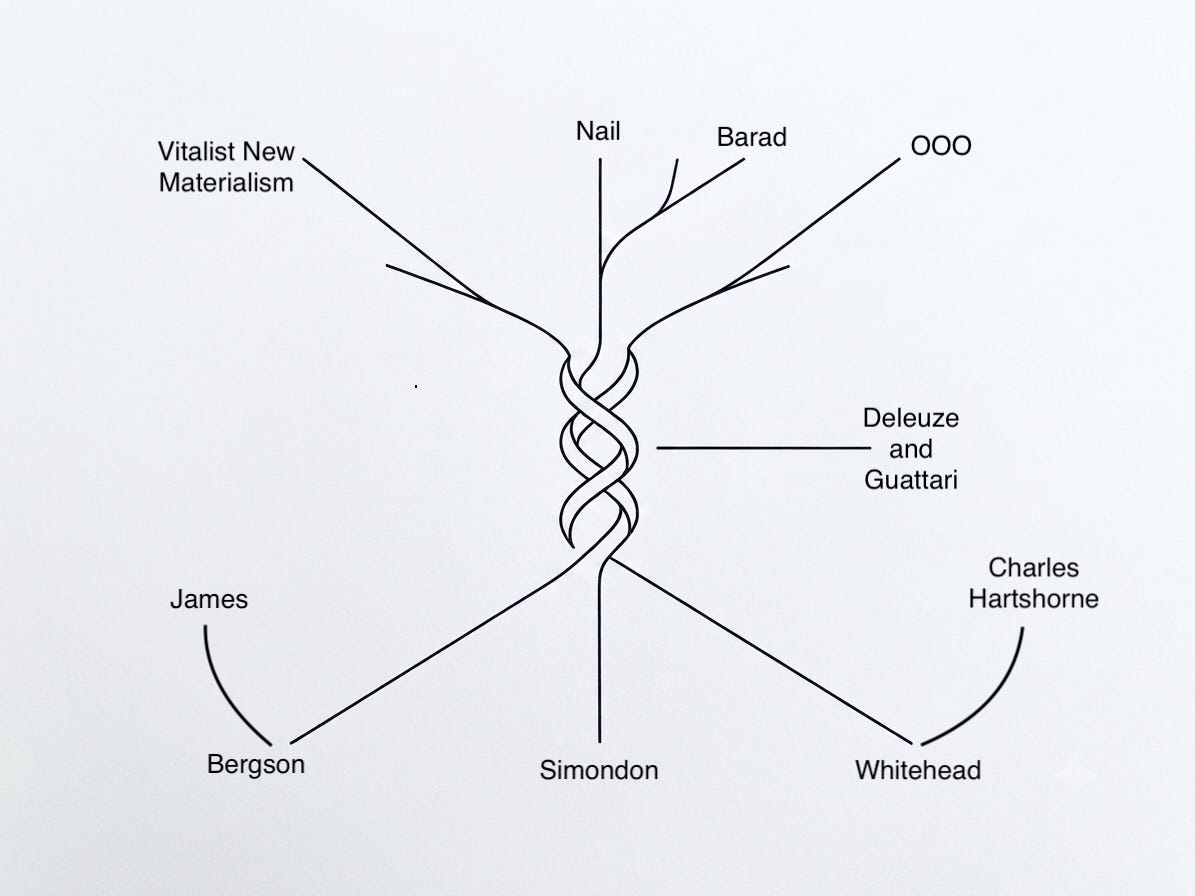
A full rendering of this tree and its relation to “new materialism” is developed in my paper, “And Yet it Moves: Process Philosophy Beyond Speculative Realism and New Materialism,” so I will just say here what is unique about kinetic materialism in all this. For me, there really is no difference between “movement” and “matter.” I use these particular words because both have always shared the very bottom of the great chain of being together in post-Axial thought. They have always been explained in terms of things higher up on the chain. This is one of many reasons I do not use the word “vital” or “life.” It is higher up on the chain and comes with a lot of unnecessary baggage from the Euro-Western tradition. The idea that “everything is vital” is the kind of ahistorical universalism I cannot abide. OOO, on the other hand, is explicitly a “transcendent” “immaterialism,” according to Graham Harman. So, this is a non-starter for me for different reasons. Many people still conflate OOO and new materialism, despite my and my co-authors best efforts to show people they are opposite views in our article, “What is New Materialism?”.[2] But there is a third view about matter: neither universal neo-vitalism or OOO, and that is the indeterminant path. Matter is indeterminate, relational, process.
With kinetic materialism I am not trying to invert the chain of being with matter/motion on top. For me, matter and motion, understood as indeterminate relational processes, are like a dark portal inside the worldview of the Euro-West. On the other side of this portal is a completely different worldview where the cosmos is immanently born out of indeterminate “chaos” like a giant cosmic tree growing in a spiral trunk up from dark primordial waters and spreading its branches out across fractal scales. Here, there is no transcendence, no god, no nature, no universal vitalism, no universal man, and no great chain of being. For the last decade, I have been standing at this portal looking back on the Indo-European-dominated Axial world imagining what it would be like if the modern-Axial world had been, contrary to its protestations, born from its darkest and most vilified substratum of moving matter (i.e. indeterminate process). That is what kinetic materialism is. It is a view of the modern world from its very outer conceptual edges, yet still residing fully inside that world, using its disciplinary academic language of “philosophy,” “ontology,” “politics,” “theory,” “concepts,” etc.
Now, I am beginning a second series of books aiming to look through the portal and try to understand the worldview on the other side. On the other side is the non-axial world, before and outside the emergence of any forms of transcendence (God, Nature, or Man). It is the world of the oldest ancient and indigenous chaosmogonies. The first two books (The Birth of Chaos and The Birth of Order) are written and should be out in 2027 in English, but it would great to have them translated into Chinese, especially since there are chapters on ancient Chinese cosmogony.
ZX: Your philosophy draws extensively on Lucretius and ancient atomism. What makes Lucretius such an important resource for your project of new materialism and the ontology of motion?
TN: Lucretius showed me the way to chaos with his description of the swerve. In his description of the swerve, indeterminacy = matter = motion. This is the magic formula of kinetic materialism. Many people have read Lucretius, of course, but only a few saw the full implications of his view. In his dissertation, Karl Marx, understood that “atoms do not exist” because they disappear completely in the “absolute immanent movement,” of the swerve. In her translations of Lucretius’ De Rerum Natura, Virginia Woolf located the oldest descriptions of what she called “moments of being,” where one sees/feels the world for what it is, indeterminate relational processes. Lucretius was also the last in the Euro-West to sing the cosmogony of the archaic poets: that the cosmos was born from a dark indeterminate but generative chaos and will return to it.
ZX: In Being and Motion, you propose that reality is composed not of static substances but of patterns of motion.[3] Could you explain how this kinetic ontology redefines traditional metaphysical questions about being?
TN: There is no physical experimental evidence for anything in this cosmos so far that does not move. I am open to revising my view with new evidence, but until I see counter-evidence, I am going with what we know so far: movement and entropy. This is why I call the ontological of movement a “historical ontology of movement” in Being and Motion. Many people at a quick glimpse just think I am claiming “Being = Motion,” but that would make no sense. That is basically saying the top of the great chain of being = the bottom of the chain. Once you do that, the whole thing falls apart and something else is happening that requires a change in all the terms. That is what Being and Motion is about. Simply from the point of observation, any view that does not begin with motion as cosmically fundamental is pure speculation neither provable nor disprovable. And those are not the kinds of questions I am trying to “answer.”
What is traditionally called “Being” or “Metaphysics,” is a non-starter from my perspective. But if we don’t like them, what options do we have? We can either get rid of the study of ontology as “being,” which is not easy to do because of how deeply it is baked into the Indo-European language family and its post-axial global influence on philosophy, or we can try to redefine the word “being” and “ontology” so they mean something like “world-in-motion.” Of course, that second option is one of things I tried to do in Being and Motion. But now in my next book series (five books) I would like to look at non-axial texts that avoid the whole problematic framework of ontology to begin with. It’s much harder work in some ways, but I am finding it very rewarding.
Addison Zexing Fan: Could ontology of movement offer a methodological basis for empirical studies of culture, politics, economy, etc.? Or, perhaps just out of my curious guess, is it possible to establish kinetic materialism upon analyses of historical dynamics of capital, or other kinds of natural-social relations (foedera), without ontology?
TN: This is exactly what all my books in the first series have tried to do. What if instead of talking about subjects and objects, we think of them as processes and patterns all nested inside each other across scales. Cosmic history, Earth history, human history, political history, aesthetic history, etc. Each iterate similar kinetic patterns across scales like fractals. This is what I have done with the concepts of centripetal, centrifugal, tensional, and elastic motion. The patterns of motion all fit together as energy spreads out from high concentrations to lower ones. These are primary. Ancient slavery, medieval aesthetics, capitalist migration are not determined by the patterns but are the ways that available energy improvises and creates or gets stuck as it spreads. I am not sure what you mean by “without ontology?” Ontology is the heart of the entire axial world. You can try to redefine ontology as “becoming,” as process philosophy does, or you jump ship on the whole cosmovision of the axial world. You can’t just look at social relations in a cosmological vacuum.
ZX: In Theory of the Object (2021), you propose that objects should not be understood as static entities but as patterns of motion or flows. Could you elaborate on how this kinetic theory of the object differs from more traditional metaphysical accounts of objects?
TN: “Objectivists” say that objects are static, self-enclosed blocks of spacetime, which pre-exist their discovery by humans. For the objectivist, objects lie in wait, possibly unchanged for millions of years, until they are ‘discovered’ by humans. An extreme example of this kind of objectivism is that nature consists of geometric and unchanging mathematical forms. Since these forms remain unchanged by knowing them, objectivist mathematics and logic claim to have discovered a static and eternal ‘language of nature.’
“Constructivists” say an object is a fixed mental state of an observer or group of observers. Instead of progress through trial and error, the constructivist thinks that any correspondence between what a subject thinks about an object and the object itself is entirely arbitrary.
“Relational ontologists” say that an object is nothing other than the set of all its relations with other objects. In one popular version of this theory called Actor-Network Theory, relationships are primary, and objects emerge as nodes from pre-existing networks. Objects are what they do or how they act through their distributed systems. In a relational ontology, there is no such thing as an unrelated object.
This last theory is the most recent and the most different from the previous three. In object-oriented ontology, everything is objects and relations. Like the relational view of objects, this view agrees that objects connect in networks of changing relations. However, for object-oriented ontologists, objects are not reducible to their relations. Objects are ‘discrete’, ‘stable’, ‘unknowable’ ‘things-in-themselves’ with ‘definite boundaries and cutoff points’. Each object is ‘vacuum-sealed’ off from others and contains within it a secret or ‘withdrawn essence’ that is ‘singular’ to it alone. Graham Harman, a founder and proponent of this theory, describes it as a kind of Kantianism without a subject – everything is an unknowable object in-itself.
These four theories of the object above could not be more different. Yet they all try to explain the object’s movement by something that does not move (an essence, a mental/social representation, a flat relationality, or an utterly inactive essence). The problem here is that all four theories start with a division either between subject and object or between object and relation.
The philosophy of movement is a kind of process philosophy. This means that instead of treating objects as static forms, it treats them as metastable processes. Some movements are small and allow the object to remain relatively stable, like a river eddy. Other movements are more dramatic and can either destroy or transform objects, like a turbulent rainstorm. Instead of trying to explain movement by something else, the critical difference is that the philosophy of movement starts from the historical situation that everything is in motion. From this perspective, I agree with Harman that objects are singular. We cannot reduce them to their determinate parts or relations (as in relational ontology). However, for me, this is because the movements of matter that comprise objects are not fundamentally determinate. Matter, or what physicists would more precisely call ‘energy’, at its smallest level, is ‘indeterminate fluctuations’. These fluctuations are not particles, substances or objects, and we cannot directly observe or know them. Complaining that this means objects are “reduced” to indeterminate energy, as Harman does, makes no sense. There is no determinate ‘something’ that is at the heart of the reduction.
Instead of starting with stasis and trying to explain movement and process, Theory of the Object inverts this logic. It begins from the historical discovery of quantum flux and then tries to explain the emergence of stable scientific knowledge.
ZX: In the same book, you also describe objects as historically evolving regimes of motion. How does this historical approach to objects help us understand transformations in technology, social organization, or material culture?
The argument of my books is that ontology, science, politics, and aesthetics are all interrelated aspects of the same historical patterns of motion as they mix and dissipate energy through space. I could imagine re-writing all my books around the time periods (prehistory, ancient, early modern, contemporary) instead of by theme (ontology, science, politics, and art). That is what I would need to do to fully answer this kind of question. Or one could read my books in this way and fill in the gaps with their own connections. But the key idea is that during a certain time period in the geographies I treated, we can see that the ontology, science, politics, and aesthetics of that time period all share a dominant (not single) pattern of motion. To try and answer your question: what look like totally separate technological, aesthetic, social, scientific, and ontological events during this time period are all relatively simultaneous changes in a single dominant pattern or “regime” of motion at a larger scale of spacetime.
AF: In your close reading of Marx’s Doctoral Thesis, in the first chapter of Marx in Motion, you explained Marx’s unfolding (aufheben) in contrast to Hegel’s negation (aufheben).[4] To me, it sounds like a much stronger position than just saying Marx’s use of aufheben stands for a different kind of negation or sublation. Why did you choose such an unusual yet very fascinating translation, and do you have some more theoretical concerns behind this choice?
TN: The German word aufgehoben is crucial to understanding the kinetics at work in this core passage of the doctoral dissertation. The English translation “negation” may make some readers think of logical negation and strict opposition, which in turn assumes the discrete identity of the original term being negated. This cannot possibly be what Marx had in mind, precisely because there can never be a discrete separation of the threefold motions to begin with. The German word aufgehoben, borrowed from Hegel, is by contrast an explicitly kinetic term describing three moments of a single process: a raising up from the ground that both leaves the ground behind and retains a relation to it. It is a process of unfolding just like a plant or flower unrolls out of itself, developing itself. This image of the plant/flower is one Hegel gives of aufgehoben.
AF: In chapter five of Marx in Motion (2020), you focused on Marx’s rich and nuanced concept of metabolism and metabolic drift. You also pointed out that metabolism “is a relatively recent and crucial emphasis in eco-Marxism”.[5] Could you explain how your study on Marx’s early Epicurean–Lucretian influence helps unravel some gists of metabolism from Grundrisse to Capital, or perhaps even concerning his later works?
TN: Metabolism in Marx is basically just the idea of metastability. Marx takes from Lucretius the idea that nature is absolute swerving motion that coalesces or weaves into metastable forms called “nature” “society” and “human,” intertwined metabolisms. This is also how Lucretius described the objects around us as collections of flying matters (simulacra) that come together and fall apart over time. Marx takes the basic physical idea of metastability from Lucretius and then looks at what capitalism does to metastable systems when it pretends that they are “static objects” that can removed from their metastable patterns at will and stuck into other patterns. Since the cosmos does not work like that, big problems ensue. Capitalism fundamentally makes errors in its understanding of the physical world. Instead, it is based on the most ludicrous metaphysical abstraction ever invented: the accumulation of quality-less abstract value. Nearly every human, for 99.9% history has known that accumulation for the sake of accumulation is a horrible idea that will end poorly. Capitalism cannot help but degrade and destroy metastable metabolisms of all kinds at every scale in the name of the accumulation of surplus value. It is the peak, and probably last, novel form of transcendence that certain terribly confused humans will have invented before this global civilization finally collapses. If homo sapiens make it to the next ice age in 100,000 years, none will even remember how profoundly stupid capitalism was because nearly every trace of global civilization will be gone by then.
AF: In both Marx in Motion (2020) and your earlier book Lucretius I (2018), you mentioned quantum physics in comparison to “the primacy of sensuous material movement” in Epicurean physics.[6] It makes me recall Epicurus’s own radical move to answer the epistemological crises of formal science at the time: He re-anchored, or swerved, the criterion of knowledge from the old foundation of pre-conceived theoretical schemas to the new dogma of sense perception. He says, in Letter to Pythocles, the plurality of explanations must follow the prompts of facts or phenomena;[7] and, to use Marx’s paraphrase in Doctoral Thesis, “All senses are heralds of the true.”[8] Do you think this ancient epistemic operation could still inspire something interesting for our scientific discourses today?
TN: Absolutely. Great connection. That is what relational quantum ontology, entanglement, and observer dependence is. But we need to add to Epicurus here that the non-human world also “quantumly observes itself.” All senses (including the senses and affects of all things) are not just heralds, but also co-producers of the true. Everything relationally co-produces everything. Any science taking this point seriously at any scale of study is following through on this. By contrast, many physicists are still told to “shut up and calculate” as if entanglement were not happening at every scale. We axials are on the cusp of grasping the full implications of this but there is still so much that needs to change.
AF: At last, there is a fun question. Until today, we know very little about Lucretius’s life; in fact, the only line of his biography we have is from the 4th-century historian Jerome, who even claimed Lucretius made himself mad by using a love potion. How would you comment on Lucretius’s unique poetic style and, perhaps even, his “madness”?
TN: I think biographies about Lucretius tell us more about the people who fabricated them than they do about Lucretius. As a good Christian, Jerome sees Lucretius’ ontology of desire as a form of “madness.” As a good Christian vitalist, Henri Bergson reads Lucretius’ description of the death of the cosmos as “melancholic.” As a good neo-vitalist, Deleuze claims that Lucretius did not write book six of De Rerum Natura because it ends with the death of the cosmos and the plague at Athens. Deleuze says book six “must” have been falsified by Christians to make Lucretius’ materialist philosophy sound horrible and depressing.
For my part, I read Lucretius as a gateway figure holding open a poetic window just big enough for the early modern world to make sense of the lost archaic age of Greek poets and gods in words and style they can understand. In the old world, the cosmos was born from chaos and will return to it in death. But Lucretius’ window was also just small enough that we axials have to squint to see through it and often end up seeing what we want to: “ah, atoms!” Lucretius’s “madness” is just what he looks like to us from the axial side of the cosmovision looking glass. From the other side, it is the axial world and its belief in transcendence that looks “mad.” In the Euro-West, Lucretius was our Janus. Marx and Woolf saw the magic formula of the swerve: matter = motion = indeterminacy.
End
Thomas Nail is Professor of Philosophy at the University of Denver and author of numerous books, such as The Figure of the Migrant, Theory of the Border, Marx in Motion, Theory of the Image, Theory of the Object, Theory of the Earth, Lucretius I, II, III, Returning to Revolution, and Being and Motion. His work combines the insights of process philosophy and new materialism to develop a unique kinetic philosophy.
Zhihao Xiong completed an MA in Social and Political Thought at the University of Sussex. His work focuses on new materialism, contemporary Marxism and critical theory.
Addison Zexing Fan is currently a PhD researcher in English and Humanities at Birkbeck, University of London. His research focuses on contemporary ontology of contingencies and media critique.
Bibliography
Gamble, C. N., Hanan, J. S., & Nail, T. (2019). What is new materialism? Angelaki, 24(6), 111~134. https://doi.org/10.1080/0969725X.2019.1684704.
Johns, C., & Bensusan, H. (edit). (2025). After speculative realism (first edition). Bloomsbury Publishing Plc. https://doi.org/10.5040/9781350410435.
Laertius, D. (1925). Lives of Eminent Philosophers: Vol II. William Heinemann & G. P. Putnam’s Sons
Marx, K. (1975). Karl Marx Fredrick Engels Collected Works: Volume 1, Marx: 1835-1843. Progress Publishers & Lawrence and Wishart & and International Publishers
Nail, T. (2012). Returning to revolution: Deleuze, guattari and zapatismo. Edinburgh University Press.
Nail, T. (2018). Lucretius I: An ontology of motion. Edinburgh University Press. https://doi.org/10.1515/9781474434683.
Nail, T. (2019). Being and motion (first edition). Oxford University Press. https://doi.org/10.1093/oso/9780190908904.001.0001.
Nail, T. (2020a). Lucretius ii: An ethics of motion. Edinburgh University Press. https://doi.org/10.1515/9781474466653.
Nail, T. (2020b). Marx in motion: A new materialist marxism. Oxford University Press.
Nail, T. (2021). Theory of the object. Edinburgh University Press. https://doi.org/10.1515/9781474487955
[1] Nail, T. Returning to Revolution: Deleuze, Guattari and Zapatismo. (Edinburgh University Press, 2012).
[2] Gamble, C. N., Hanan, J. S., & Nail, T. “What is new materialism?” Angelaki, 24(6), (2019): 111-134, https://doi.org/10.1080/0969725X.2019.1684704.
[3] Nail, T. Being and Motion (first edition). (Oxford University Press, 2019), https://doi.org/10.1093/oso/9780190908904.001.0001.
[4] AF: Note that I have misinterpreted Nail’s point here, and the author will explain himself clear in the answer.
Nail, T. Marx in Motion: A new materialist Marxism. (Oxford University Press, 2020), 23.
[5] Ibid, 100.
[6] Nail, T. Lucretius I: An ontology of motion. (Edinburgh University Press, 2018). https://doi.org/10.1515/9781474434683.
[7] Laertius, D. “Book X: Epicurus,” in Lives of Eminent Philosophers: Vol II. (William Heinemann & G. P. Putnam’s Sons, 1925), 615-617.
[8] Marx, K. “Difference Between the Democritean and Epicurean Philosophy of Nature,” in Karl Marx Fredrick Engels Collected Works: Volume 1, Marx: 1835-1843. (Progress Publishers & Lawrence and Wishart & and International Publishers, 1975), 39.